
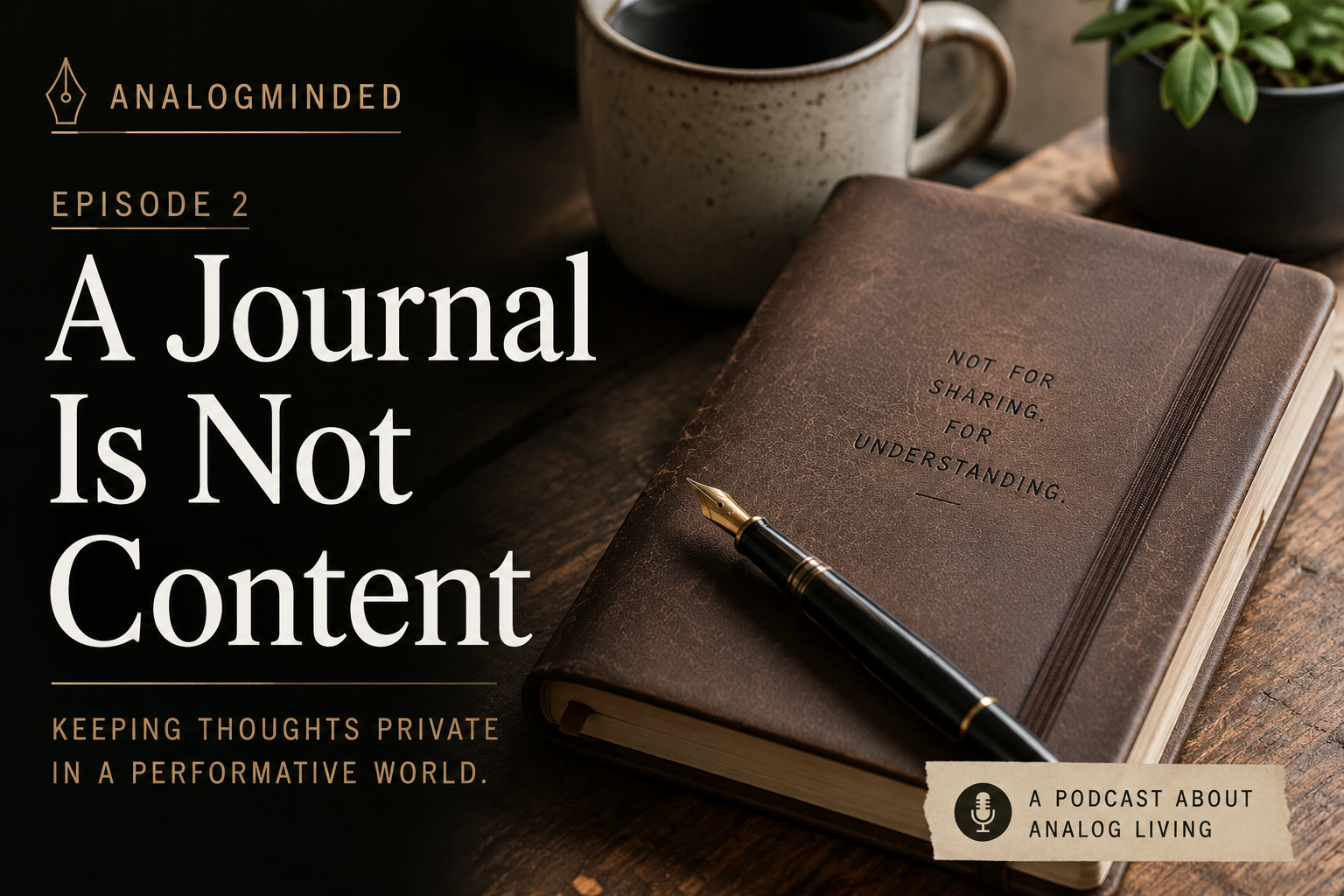
There’s a strange pressure in modern life to share everything.
Every thought. Every experience. Every moment.
In Episode 2 of the AnalogMinded podcast, we explore the increasingly performative nature of digital culture — and why journaling was never meant to become content for an audience.
This reflective episode considers the quiet value of private writing in a world built around visibility, social media, and personal branding. We discuss how analog journaling creates space for honesty, reflection, uncertainty, and thoughtful attention in ways that public platforms often cannot.
More than simply documenting life, a handwritten journal can become a private place to process ideas, examine emotions, and slow down long enough to understand what we actually think.
In This Episode
- Why journaling has become increasingly performative
- The difference between reflection and content creation
- The importance of private creative spaces
- Analog journaling and mindful living
- Writing by hand in a distracted digital world
- Why not everything meaningful needs an audience
- Fountain pens, notebooks, and reflective writing
- Slowing down and thinking more honestly
Reflective Writing in a Performative Culture
One of the central themes of this episode is the tension between private reflection and public performance.
Today, many experiences can begin feeling incomplete unless they are shared online. Over time, this changes not only how we communicate — but also how we think and experience life itself.
Instead of asking:
“What do I actually think about this?”
we often begin asking:
“How will this appear to other people?”
That subtle shift changes journaling too.
Private journals historically existed as unfinished spaces — places where thoughts could remain uncertain, contradictory, messy, and honest. Unlike social media, journals were never designed for engagement, visibility, or personal branding.
And perhaps that privacy is exactly what makes them valuable.
Why Physical Journals Feel Different
This episode also reflects on the tactile nature of analog journaling.
The texture of paper.
The sound of turning pages.
The slow movement of writing by hand.
Ink drying across a notebook page.
These physical experiences slow thought down in meaningful ways.
Unlike typing quickly on screens, handwriting naturally creates space for reflection. Thoughts unfold more gradually. Emotions become easier to examine honestly. The process becomes less about broadcasting outward — and more about listening inward.
Journals Preserve Ordinary Life
Another theme explored in this episode is the way journals preserve life differently than social media.
Online platforms often capture curated highlights.
But journals tend to preserve ordinary reality:
- small observations
- unresolved questions
- quiet fears
- fleeting thoughts
- fragments of everyday life
And years later, those details often become the most meaningful part.
A journal remembers who you actually were — not simply how you appeared publicly.
Final Reflection
Maybe not every thought needs to become content.
Maybe some thoughts deserve quiet space to exist privately first.
And perhaps that’s part of the beauty of analog living — creating spaces where reflection matters more than performance.
Slow down.
Write honestly.
Stay AnalogMinded.